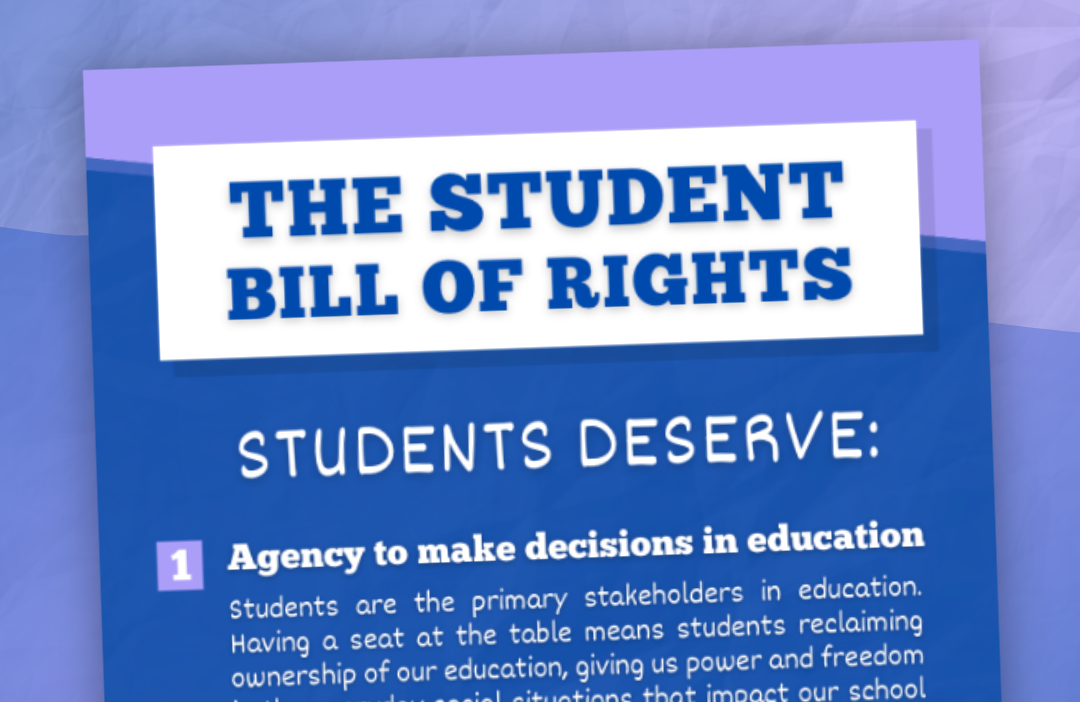
1. Agency to make decisions in education.
Having a seat at the table means students reclaiming ownership of our education, giving us power and freedom in the everyday social situations that impact our school experiences, and thus, our futures. We shall not be tokenized as an outsider or subjugated as political pawns in decisions most impacting us. Our voices have power.
Students are the primary stakeholders in education, but we are traditionally excluded from policy-making decisions in school boards and the state legislature. Officials cannot best represent students when they cultivate a "power over" relationship instead of "power with" students.
School boards directly influence education policy about students, often without us. These governing bodies should sufficiently include students in conversations, roundtables, workshops, committees, and most importantly, on the same dais where they legislate.
2. High quality public education for all.
Education is a cornerstone of community and democracy. Students spend a significant portion of our childhood and adolescence in a classroom, and we want it to mean something for us. We want education to be a highlight of our youth and fulfill our sense of confidence.
Public schools must serve everyone to the fullest extent, throughout rural and urban communities, regardless of socioeconomic disparities. Students should face no entry barriers to accessing a quality education meant to help us learn and grow alongside peers. We can address chronic absenteeism by taking measures to uphold quality education.
Strong teachers help shape strong students. Our student experiences are defined by educators’ working experiences. We must invest in a workforce of educators who are duly committed to students, highly competent, and sufficiently compensated for teaching demands.
Trust is critical to students’ relationships with adults at school. Students should feel that our educators and administrators care about our needs as individuals, not merely as numbers or written records. Retention of educators and cultivating a school community of joy serves everyone.
The quality of facilities significantly influences students’ desire to attend and thrive at school. Students deserve functioning facilities with prime infrastructure, free from dangers to student health, including excessive temperatures, harmful substances, or biohazards.
Students deserve the right to school libraries that provide access to resources and knowledge, in the form of books, the Internet, guidance by librarians, and more. Libraries and classrooms shall be boundless for fostering exploration, imagination, and possibility.
Schools should be a support system meant to break cycles of marginalization. Not all families can or want to be involved in fostering a student’s educational trajectory. Education systems must be accountable to helping first-generation or dropout-prone students thrive, despite any potential barriers like wealth or citizenship status.
3. Safe and welcoming school environments conducive to growth.
When students enter school each day, we should not fear gun violence, bullying, harassment, or a prison sentence. School should support students coming as we are, with limited English proficiency or in proximity to the impact of substance abuse. Schools can make a difference in a student’s life if it becomes a central goal for education.
Gun violence is a public health epidemic and a reality for Generation Z and Alpha. These cycles of violence do not need to be a broken record. We are ready to turn the page toward safe storage measures and preventing guns from ending up in the hands of anyone in crisis or who has made threats of violence toward themself or others.
Let’s educate, not incarcerate. Student discipline must improve situations, not worsen them. School officials have the subconscious power to permanently affect a student’s life trajectory. Instead of punitive alternative programs, racially biased to involve students of color, restorative practices can help shatter the school-to-prison pipeline.
The carceral state disproportionately harms marginalized youth and establishes no accountability. Incarceration costs excessive public dollars and too often repeats with recidivism. We must invest in students’ future as leaders, not victims of a broken juvenile system.
Education systems should enforce contemporary, comprehensive anti-discrimination policies that protect all students. We can cultivate compassion in school culture for students to best learn and grow skills needed in adulthood.
Ensuring schools take proactive measures to prevent drug abuse and support affected students is essential for fostering overall student well-being. Actions by school and public officials, instead of complicity or roundabout attempts at solutions, can contribute to safer educational environments.
Bilingual education should serve students from a variety of language backgrounds. Texas is a multilingual state. Our education system should empower, not shame, native tongues and language learning.
Children are one of the most disabled groups of people. Disabled and neurodivergent students should not be unfairly punished or judged for behavioral actions considered outside of normative societal standards.
When environments are not safe, students should be aware of processes for reporting issues or talking to trusted adults who will advocate for us. School professionals should hold responsibility toward protecting students with utmost integrity regardless of school pressures.
4. Freedom of expression in a pluralistic, multicultural democracy.
To freely express ourselves is core to shaping our lives and bettering the future. Texas is an enormous state with rich culture. Our diversity makes us great. Schools must empower students to be the best of ourselves.
Discriminatory dress codes, targeting students across gender norms and ethnic-cultural styles, distract from education and harm self-esteem. The right to our own bodies is critical, and the State belongs away.
Generation Z is the most openly LGBTQ+ generation in history. Names and pronouns are centermost in our lives. Regardless of what we call ourselves, it matters more that others refer to us in affirming ways. To support student well-being and social confidence, we must embolden inclusive community values of respect that do not give power to deadnaming and misgendering.
As lawmakers seek to blur the separation of Church and State, public schools must support students secularly and without enforcing religious customs. We should, however, learn of diverse world faiths and defend students’ individual right to religious liberty. Nationalism, especially bolstering religious doctrine, undermines faith and education.
Students clubs, organizations, and athletics should be spaces for us to explore interests, engage in social causes, and create community. Students should have equal access to lead or participate in clubs. School publications should respect student voices without censorship.
When power structures aren’t right, students deserve the unfettered ability to challenge oppression, especially when imposed by authority. Our right to assemble and petition must be protected, not trampled.
5. Holistic student care to support health and well-being.
Entering school each day, students bring a reflection of our personal lives into the classroom. Regardless of socioeconomic status, wraparound services fulfill student needs and steer us on a track to success, fostering better social and learning environments for all.
From food to healthcare, including breakfast and menstrual products, schools must fulfill our basic needs before expecting us to perform socially and academically. These services should be provided to students at no individual cost and without stipulations.
Schools should have nurses, sufficiently equipped with inhalers, epipens, insulin, overdose medication, and other necessary, potentially life-saving measures for students. All students should be generally knowledgeable of resource locations and how we can access them in an emergency.
Amid a youth mental health crisis, school counseling and seamless pathways to additional services are vital for vulnerable students to navigate trauma, substance abuse, adverse experiences, and everyday dilemmas.
Neighborhood transportation between home and school is necessary to ensure student safety and breaking barriers for students and families on financial, physical, or workplace bases.
After-school tutoring and programs, both social and extracurricular, are vital to narrowing the gap between student performance, well-being, learning loss, and at-home factors contributing to a student’s situation at school. Schools should be a community of care for students.
6. Truthful, critical, and substantive curriculum.
Students must hold agency to indiscriminately access and utilize our education in ways that affirm our identities and help us discover the unfamiliar. Teaching to an unjust status quo is a disservice to the youngest generation of Texans.
Students deserve the right to educate ourselves about sensitive topics, especially when politically contentious. To foster a love for reading and learning, no one should decide for students what we can or cannot read. We must hold the individual agency to decide which books we read.
We should trust the expertise of librarians and educators to curate age-relevant and educationally-suitable collections. Interest groups and politicians with ulterior motives should not hold greater authority over the autonomy of all families in a school system.
Curricula should represent Texas’ vast diversity in culture and ideas. We must teach the truth, with fact-based evidence and critical perspectives. Commonplace myths and false narratives make dangerous impressions on students and hold no educational suitability. If we are to act as critical thinkers, we must not lie to students. Truth must be the norm.
Education should be liberating and life-giving. To facilitate freedom, we must teach standards, not standardization. Rote memorization for heavy testing and data collection treats students homogeneously. Instead, we must give life to each students’ uniqueness, curiosity, and passion.
7. To be leaders of today, not only of tomorrow.
To best navigate the complexities of today’s Texas, students must be equipped with the education necessary for becoming a generation of success, impact, and excellence. We must be prepared for our futures so we determine and shape our trajectories. Critical thinking is crucial to becoming an active member of society.
Our 13 years in K-12 schools must adequately prepare us with resources and curriculum for financial and medical literacy. Learning to file taxes, buy a car or home, and understand legal contracts instills confidence in our socioeconomic lives. Comprehensive fact-based sex ed curriculum, with an emphasis on consent, is necessary to reduce domestic violence and STDs. This is how we build a society with competency and respect for one another.
With the integral presence of the Internet in contemporary life, we must learn responsible digital citizenship. Social media is a valuable tool in which we must safeguard our rights for free use. Big Tech should be held accountable for dangers posed to youth. Empowering students with multimedia literacy and judgment of reality facilitates a more informed, cooperative, and engaged society.
We must actualize power for civic leadership, navigating interpersonal conflict, and building professional relationships. We must be aware of our elected officials at all levels of government and understand that we play a critical role as a Fourth Branch of government. Learning how to engage in civic institutions through voting and public engagement will help us shape, not merely inherit, the world we wish to live in.
8. Streamlined and personalized pathways for lifelong learning.
Education is a life-long endeavor. Opportunities for Higher Education must be affordable, accessible, and student-oriented.
There is no singular or correct path for students. Education should challenge us to be the best of ourselves while simultaneously handing us the keys to our own academic, social, and professional journeys.
Districts should provide classroom instruction and hands-on experiences for learning Career and Technical Education.
K-12 education should prepare us for post-school opportunities that empower and encourage excellence. We should have opportunities to explore Higher Education through online research and firsthand experiences. Academic advising should be available to all students.
University finances should hold students in their best interest. We should be given an educational experience worth our investment and be spared from malicious billing practices. Financial aid should ensure any student with the interest of pursuing higher education is guaranteed such opportunity.